Running an assisted living home means keeping track of dozens of responsibilities for every resident. Service plans are among the most important.
A service plan isn't simply a form in the resident's chart. It identifies the resident's needs, the level and frequency of services the resident is expected to receive, and helps establish what caregivers are expected to provide and document.
Arizona also establishes specific deadlines for creating, reviewing, and updating these plans.
Here's what assisted living operators need to know.
Arizona service plan deadlines at a glance
| Situation | Requirement |
|---|---|
| New resident | Complete within 14 calendar days after acceptance |
| Supervisory care | Review/update at least every 12 months |
| Personal care | Review/update at least every 6 months |
| Directed care | Review/update at least every 3 months |
| Significant physical, cognitive, or functional change | Review/update within 14 calendar days |
| Respite care | Separate 3-working-day requirements apply |
The easy way to remember the regular review cycle: 12 / 6 / 3.
- Supervisory = 12 months
- Personal = 6 months
- Directed = 3 months
Keeping a service plan current, however, involves considerably more than remembering its renewal date.
What must an Arizona assisted living service plan include?
Under R9-10-808(A), the written service plan must address:
- Resident medical or health problems, and applicable physical, behavioral, cognitive, or functional conditions or impairments
- The expected level of service (supervisory, personal, or directed)
- The amount, type, and frequency of assisted-living and ancillary services
- Medication administration or assistance where applicable
- Any required professional review, for example nurse or medical-practitioner review when intermittent nursing services or medication administration are involved
- Applicable behavioral-care provisions
- Medication storage and control arrangements when medication is stored in the resident's bedroom or unit
Medication has its own detailed rule under R9-10-817, which covers administration, assistance in self-administration, verbal orders, storage, errors, and documentation. See the companion resource: Arizona Assisted Living Medication Management Requirements →
A service plan therefore shouldn't merely say:
Personal Care.
It should describe what personal care actually means for this resident.
Two residents both receiving "personal care" might have very different service plans. One might need cueing at meals and standby assistance in the bathroom. The other might need transfer assistance, incontinence care, and skin monitoring at every shift. The service plan is where that specificity lives.
Who participates in developing and signing the service plan?
R9-10-808(A) identifies three parties in the development and review process:
- The resident, or the resident's representative if a representative is designated
- The manager of the assisted living facility
- An individual requested by the resident or representative, if any
Depending on the resident's services, additional professional review may be required. Intermittent nursing services or medication administration require review by a nurse or medical practitioner. Behavioral care can trigger additional review by a professional appropriate to the resident's condition.
Signatures matter here. R9-10-808(A)(5) requires the required parties to sign and date the initial plan and any updated plan.
Operator takeaway
Don't treat signatures as something to clean up later. A clinically sensible plan can still create a documentation problem when required reviews, signatures, or dates are missing. If the plan was reviewed by the right people but no one signed off on it, the survey record has no way to show that.
Understanding the 12 / 6 / 3 rule
Supervisory care
Regular review
12
months, minimum
Personal care
Regular review
6
months, minimum
Directed care
Regular review
3
months, minimum
These are the minimum regular review frequencies under R9-10-808(A). They are floors, not ceilings. A significant change in the resident's condition still triggers a review within 14 calendar days regardless of when the last regular review occurred.
A single-resident home makes 12 / 6 / 3 easy. One annual review is easy to remember, and the resident's needs stay familiar. A 10-resident home is another matter. Different residents were accepted on different dates, are receiving different levels of service, and have different next-review deadlines. What was one date to remember becomes ten.
At that point, tracking review cycles in memory or on a paper calendar starts to fail predictably. Missed reviews become the operator's problem, even when the underlying care hasn't changed.
A significant change can change the timeline
R9-10-808(A) also requires review and update of the service plan within 14 calendar days after a significant physical, cognitive, or functional change in the resident.
This is the piece that gets missed. Regular review cycles are on the calendar. Significant changes aren't. They can happen any day, and they reset the clock for a new review before the regular deadline arrives.
Operator takeaway
Don't only ask: "When is the next service plan due?"
Also ask: "Does this change mean the current service plan no longer accurately describes this resident's needs?"
Common situations that operators should evaluate against the significant-change standard include:
- New diagnosis, or a diagnosis change
- Significant weight loss or gain
- Fall with injury, or a pattern of falls
- New or worsening behavioral symptoms
- Increased assistance needs at meals, in the bathroom, or with transfers
- Return from a hospitalization or skilled-nursing stay
- Change in cognitive status
Whether any specific change meets the rule's threshold is a judgment made in the context of that resident. The rule uses the term "significant" for a reason.
Personal care has additional service-plan requirements
R9-10-808 isn't the only rule that determines what a personal-care service plan must contain. R9-10-814(F) adds specific requirements for personal care, including:
- Skin maintenance
- Sufficient fluids for hydration
- Incontinence care that supports the resident's highest practicable level of independence when toileting
- Applicable practitioner determination under the circumstances described in the rule
A service plan that addresses the R9-10-808(A) requirements without also addressing the R9-10-814(F) requirements for a personal-care resident is incomplete.
Directed care requires additional attention
Directed-care residents receive the most intensive level of assisted-living service in Arizona. R9-10-815(C) adds requirements to the service plan on top of R9-10-808(A) and any applicable personal-care requirements.
Directed-care service plans should address:
- The applicable personal-care requirements from R9-10-814(F)
- Cognitive stimulation and activities appropriate to the resident
- Personal-safety strategies appropriate to the resident's cognitive status
- Encouragement to eat meals and snacks as needed
- Weight documentation, or documentation that a practitioner has contraindicated it
- Communication coordination between caregivers, family, and applicable professionals
- Additional requirements when the resident is also receiving memory-care services
Directed care isn't simply "the same service plan every three months." Each three-month review is an opportunity to check whether the plan still fits how the resident is actually presenting.
Arizona amended R9-10-808 and R9-10-815 effective June 30, 2025. If you built your service-plan templates before that date, review them against the current rule text.
Respite care works differently
Respite care has its own framework in R9-10-808(B).
- The service plan is generally completed within three working days after acceptance
- If a qualifying service plan developed within the previous 12 months exists, it can instead be reviewed and updated within those three working days
- A significant change during respite care triggers an update within three working days
Don't automatically apply the 14-day rule to a respite resident. Respite residents are moving through the facility on a shorter horizon, and the rule's deadlines reflect that.
A current service plan isn't enough
Having a service plan on file is only part of the requirement.
R9-10-808(C) requires caregivers and assistant caregivers to provide assisted-living services and ADL assistance according to the service plan, and to document the services provided in the medical record.
R9-10-811 further requires the resident medical record to contain the service plan and its updates, and documentation of assisted-living services provided.
There is an important difference between care that was provided and care that can be demonstrated from the record. A resident may have received attentive, appropriate care every shift for months. If the documentation doesn't reflect that care, the record can't demonstrate it during a survey.
Your service plan and documentation should tell the same story
Each link in this chain should reinforce the others.
- If a service plan says a resident receives assistance with an ADL but the documentation consistently shows nothing, there's a gap in the record.
- If caregivers routinely provide services not reflected in the current plan, that can be a reason to evaluate whether the plan still accurately describes the resident's needs.
- If a significant change occurs while the plan continues to describe the resident as they were months earlier, the document may no longer reflect current needs.
Good compliance isn't simply: "Do we have the form?"
A better question is: "Does the resident's record consistently tell the story of the care we're actually providing?"
Common service-plan mistakes to watch for
Not every item below constitutes the same type or severity of deficiency, and context matters in every case. These are practical risk areas worth watching:
- Missing the initial 14-day deadline after acceptance
- Using the wrong regular review interval for the resident's level of service
- Failing to update after a significant change
- Missing required signatures or reviews
- Failing to identify the appropriate level of service
- Leaving required services vague or incomplete
- Missing additional personal-care or directed-care requirements
- Providing services without documenting them in the medical record
- Allowing care documentation and the service plan to tell different stories
A simple service-plan workflow for a small assisted living home
Five questions worth asking about every resident on a regular cadence:
- What level of service is this resident receiving?
- When was the current service plan completed?
- When is the next regular review due?
- Has something happened that requires an earlier review?
- Does our documentation support what the service plan says we're providing?
The first three are calendar work. The last two require someone to actually look at the resident and the record together.
Knowing what's required is easy. Keeping track of everyone is harder.
One resident's service-plan deadline isn't difficult to remember. A home full of residents with different acceptance dates, levels of service, review intervals, and changing conditions is another matter.
That's one of the problems Tendera was built to solve. Tendera helps Arizona assisted living homes keep upcoming resident and compliance obligations visible so teams can address them before they become overdue, without depending on another spreadsheet, paper calendar, or someone's memory.
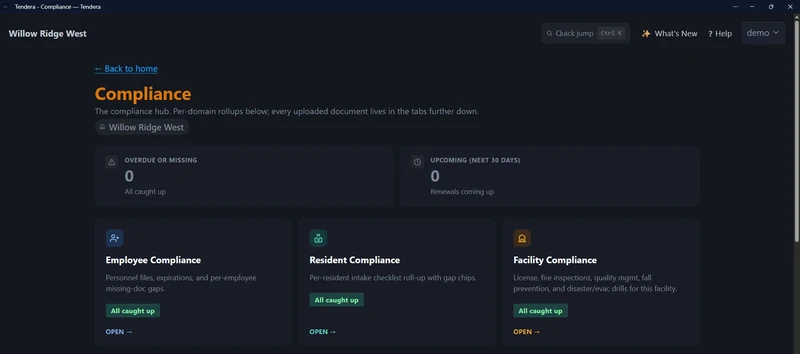
Tendera brings resident care, documentation, and compliance workflows together in one operating system built specifically for Arizona assisted living homes.
In Tendera, each resident's service plan carries its level of care and next review date, and reviews coming due appear on the Compliance hub next to the other resident chart items.
See how Tendera tracks service plans →FAQ
How soon after acceptance does an Arizona assisted living resident need a service plan?
Under R9-10-808(A), the written service plan must be completed no later than 14 calendar days after acceptance. Respite care has its own separate 3-working-day framework under R9-10-808(B).
How often are supervisory-care service plans updated?
At least once every 12 months, subject to earlier updates required when a significant change in the resident's condition occurs.
How often are personal-care service plans updated?
At least once every six months, subject to earlier updates required when a significant change occurs. Personal-care service plans also must address the additional requirements in R9-10-814(F).
How often are directed-care service plans updated?
At least once every three months, subject to earlier updates when a significant change occurs. Directed-care service plans have additional content requirements under R9-10-815(C).
Does a service plan need to be updated when a resident's condition changes?
A significant physical, cognitive, or functional change triggers review and update of the service plan within 14 calendar days under the general R9-10-808(A) rule.
Are respite-care service plans different?
Yes. Under R9-10-808(B), respite-care service plans are generally completed within three working days after acceptance. If a qualifying service plan developed within the previous 12 months already exists, it can be reviewed and updated within that same three-working-day window. A significant change during respite care triggers an update within three working days.
Primary authority & further reading
- Arizona Administrative Code, Title 9, Chapter 10 (Health Services; Health Care Institutions Licensure), published by the Arizona Secretary of State.
- R9-10-808 — Service Plans.
- R9-10-814 — Personal Care Services.
- R9-10-815 — Directed Care Services.
- Arizona Department of Health Services — Residential Facilities Licensing, the licensing agency for Arizona assisted living facilities.
Last reviewed: August 2026.
This resource provides general information for Arizona assisted living operators and is not legal advice. Regulations and agency guidance may change. Operators should verify current requirements with ADHS and applicable Arizona law and consider the circumstances of their facility and residents.