First: understand what kind of medication service is being provided
Not every resident taking medication represents the same facility workflow. Arizona's medication-services rule addresses three distinct patterns, and each carries its own requirements.
R9-10-817(B)
Medication administration
The facility administers medication to the resident. Storage, order compliance, refusal documentation, and medical-record documentation of administration all sit with the facility.
R9-10-817(C)
Assistance in self-administration
The resident takes the medication. Staff provide only the specific kinds of assistance the rule describes: reminders, opening containers or organizers, observation, and applicable verification.
Self-administration
Resident self-administration
The resident manages their own medication under circumstances applicable to their care or service plan and the facility's processes.
Operator takeaway
These terms are not interchangeable.
Before designing a medication process for any resident, the operator first needs to understand what medication service is actually being provided. The workflows, the staff practices, the documentation, and the policy references are different for each. This resource does not offer generalized legal advice about who may administer medications; that is a question for current Arizona law and applicable medical-practitioner direction.
What your medication policies need to address
R9-10-817(A) requires the assisted living facility to establish, document, and implement policies and procedures that address a number of operational areas. Translated into plain language, these include:
- Preventing, responding to, and reporting medication errors
- Responding to and reporting unexpected medication reactions
- Ensuring a resident's medication regimen and method of administration are reviewed by a medical practitioner to determine whether they meet the resident's needs
- Documenting medication administration
- Documenting assistance in self-administration
- Monitoring residents who self-administer
- Assisting residents in procuring medications
- Medication services provided off-premises where applicable
- Medication administration for residents receiving memory-care services where applicable
Operator takeaway
A good medication system is more than a MAR.
The MAR records what happened. The facility's medication-services process also has to address what happens when something goes wrong, changes, is unavailable, occurs off-site, or requires follow-up. The MAR is the operational output. Policies are the operational spine.
A verbal order starts a deadline
When the assisted living facility receives a verbal medication order from a medical practitioner, the current rule at R9-10-817(A)(2) requires:
- The manager or a caregiver takes the verbal order
- The order is documented in the resident's medical record
- Written verification from the medical practitioner is obtained within 14 calendar days after the verbal order is received
Verbal medication order → document immediately → written verification within 14 calendar days.
The operational risk isn't the order itself. It's a verbal order that gets acted on, documented in the moment, and then never receives written confirmation because everyone assumed someone else was handling it. A verbal order should never become an undocumented loose end.
If your facility administers medication
R9-10-817(B) establishes requirements when the facility administers medication. Among them:
- Medication is stored by the assisted living facility
- Medication-administration policies and procedures are reviewed and approved by a medical practitioner, a registered nurse, or a pharmacist
- The process addresses documentation of individuals authorized to administer under applicable law and medical-practitioner direction
- Medication is administered only as prescribed
- Resident refusals are documented
- An administered medication is:
- Administered by an individual under the direction of a medical practitioner
- Administered in compliance with the medication order
- Documented in the resident's medical record
Delegation and scope-of-practice questions become legally nuanced quickly. Facilities should follow current Arizona law and applicable medical-practitioner direction rather than rely on generalized summaries for those specifics.
The order, the administration, and the record should agree.
Assistance does not mean simply handing someone pills
Where the facility provides assistance in self-administration, R9-10-817(C) describes the kinds of assistance that may be provided:
- Reminding the resident that it's time to take medication
- Opening the medication container or organizer
- Observing while the resident removes the medication
- Applicable verification of:
- Resident identity
- Dosage
- Medication time
- Verification of the organizer schedule when an organizer is used
- Observing the resident while the resident takes the medication
Assistance must still comply with an order and must be documented in the resident's medical record. Policies and procedures for assistance in self-administration must also receive the professional review and approval required by the rule.
Operator takeaway
Administration and assistance in self-administration are different workflows. Your policies, your staff practices, and your documentation should reflect the difference. A single resident may move between these two workflows over time as their needs change.
Who can fill a resident's medication organizer?
R9-10-817(E) identifies specific categories that may fill a medication organizer:
- The resident
- The resident's representative
- A family member
- Personnel from a home health agency or hospice service agency
- The manager or a qualifying caregiver under the circumstances established by the rule
The last category carries more nuance than a summary can convey. The rule ties it to designation and applicable medical-practitioner direction under specified circumstances. Read the current rule text before assuming the facility manager or any caregiver may routinely fill organizers.
Operator takeaway
Don't assume that because someone can assist a resident with medication, that same person may fill a medication organizer under every circumstance. These are separate authorities in the rule.
Medication storage is part of medication management
When the facility stores medications, R9-10-817(F) requires:
- Medication is kept in a separate locked room, closet, cabinet, or self-contained unit used only for medication storage
- Medication is stored according to the instructions on the container
Policies and procedures must also address:
- Receiving
- Storing
- Inventorying
- Tracking
- Dispensing
- Discarding medications, including expired medication
- Applicable manufacturer-requested discard or return of prepackaged or sample medication
- Recalls and notification of affected residents
- Controlled-substance storage, inventory, and dispensing
The rule requires policies and procedures for controlled-substance inventory. It does not itself specify a count frequency. Facilities that use weekly controlled counts do so as an internal practice; that is a facility-level decision to make with pharmacy input, not a rule number to memorize.
For a deeper walkthrough of the storage-side requirements — what counts as an acceptable location, container-instruction storage, controlled-substance procedures, discard and recall, and the resident-room distinction — see the companion Arizona Assisted Living Medication Storage Requirements guide.
What if a resident keeps medication in their room?
Not every resident's medication lives in the facility's locked medication-storage area. R9-10-817(H) addresses medication that a resident keeps in their bedroom or residential unit:
- Medication should be stored according to the resident's service plan, or
- If the storage arrangement differs from what the service plan says, the service plan must be updated to describe how the medication is being stored
This is a very good example of why medication management and service planning can't be treated as disconnected compliance silos. A change to the medication storage arrangement is a change to the service plan. For more on when and how service plans get created, updated, and signed, see the companion resource: Arizona Assisted Living Service Plan Requirements →
When something goes wrong, the response matters too
R9-10-817(G) requires a caregiver to immediately report:
- A medication error, or
- A resident's unexpected reaction to medication
to the medical practitioner who ordered the medication, or another medical practitioner if the ordering practitioner is unavailable.
Facility policies and procedures must also address preventing, responding to, and reporting medication errors and unexpected reactions. That policy work is separate from any clinical instruction the practitioner may give in response.
Medication safety isn't only about preventing mistakes. It's also about having a clear, documented response when one occurs.
This resource is not a substitute for emergency procedures, practitioner instructions, or facility policy. Nothing here is medical advice.
Don't overlook the reference requirement
R9-10-817(D) requires the manager to ensure personnel have access to:
- A current drug reference guide
- A current toxicology reference guide
Small requirement, easy to miss during a survey. Worth confirming that whichever reference the facility uses is current, whether it's a book on the desk or a digital resource.
Documentation is the thread connecting everything
The current medication-services rule repeatedly ties medication activity to the resident's medical record. Verbal orders, administration, refusals, assistance in self-administration, medication errors, and unexpected reactions all connect back to what the record demonstrates.
A caregiver may remember giving a medication. A manager may know that a physician called with a new order. Survey readiness depends on what the record can demonstrate.
Good medication documentation should answer a simple question:
What happened, when, for whom, under what order, and who documented it?
Common medication-management risk areas
Not every item below constitutes the same type or severity of deficiency, and context matters in every case. These are practical risk areas worth reviewing:
- Medication administration that doesn't match the current order
- Missing or incomplete documentation
- Refusals not documented
- Verbal orders that never receive timely written verification
- Confusing medication administration with assistance in self-administration
- Medication stored outside the required locked medication-storage area when facility storage rules apply
- Medication stored contrary to container instructions
- Expired or discontinued medication remaining in active storage
- Medication organizer practices that don't align with the rule
- Resident-bedroom medication storage that isn't reflected in the service plan
- Medication errors or unexpected reactions without the required reporting response
- Policies that don't reflect what staff actually do
A simple medication workflow for operators
For every resident receiving medication services, an operator should be able to answer:
-
What medication service is being provided?
Administration, assistance in self-administration, or resident self-administration.
-
Do we have a current order?
And does the current instruction match what staff are following?
-
Does the medication itself match the current instruction?
Resident, medication, dosage, time, and applicable instructions should all be clear to the caregiver.
-
Is the medication being stored correctly?
Including applicable locked storage, container directions, and service-plan requirements when the resident stores medication in their room.
-
Can the record show what happened?
Administration, assistance, refusals, and relevant changes should be documented according to the applicable requirements.
-
Are exceptions visible?
Verbal orders, medication errors, unexpected reactions, discontinued medications, and other exceptions should not disappear into memory or informal communication.
Medication pass is simple. Medication management isn't.
A medication pass may look straightforward from the outside: resident, medication, time, document. In a real assisted living home, caregivers also have to keep track of current orders, instructions, refusals, vitals, hold parameters, PRNs, changes, documentation, and exceptions.
That's why Tendera's medication workflow was built around more than a list of medications.
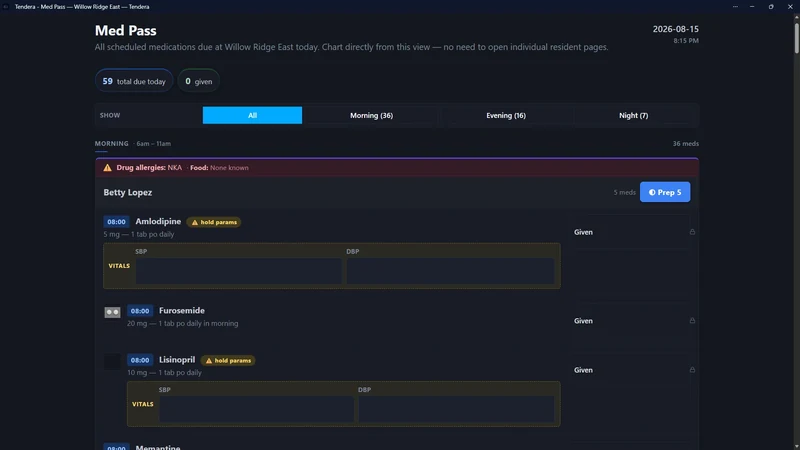
Tendera helps caregivers see what is due, what needs attention, and what has already been documented, while giving managers a clearer audit trail across the home. It supports medication-management processes; it does not replace practitioner direction, pharmacy expertise, or facility policy.
FAQ
What Arizona rule governs medication services in assisted living facilities?
A.A.C. R9-10-817 addresses medication services for Arizona assisted living facilities. It became effective in its current form on June 30, 2025.
Is medication administration the same as assistance in self-administration?
No. R9-10-817(B) and R9-10-817(C) establish separate frameworks. Administration is the facility administering medication to the resident. Assistance in self-administration is the resident taking the medication while staff provide specific kinds of assistance the rule describes. Who may perform each is a scope-of-practice question that depends on current Arizona law and applicable medical-practitioner direction.
How long does an Arizona assisted living facility have to get written verification of a verbal medication order?
Under the current rule, written verification must be obtained from the medical practitioner within 14 calendar days after receiving the verbal order.
Do medication refusals need to be documented?
Where the facility provides medication administration, the medication-administration policies and procedures must address documentation of resident refusals in the medical record.
Does medication stored by the facility have to be locked?
When medication is stored by the assisted living facility, R9-10-817(F) requires a separate locked room, closet, cabinet, or self-contained unit used only for medication storage, and medication must be stored according to the instructions on the container.
Can a resident keep medication in their bedroom?
R9-10-817(H) addresses resident-bedroom or residential-unit medication storage and ties the storage arrangement to the resident's service plan. If storage differs from what the service plan describes, the service plan must be updated.
What happens after a medication error?
R9-10-817(G) requires immediate reporting by a caregiver to the ordering medical practitioner, or to another medical practitioner if the ordering practitioner is unavailable. Facility policies must also address preventing, responding to, and reporting medication errors. Clinical response is a matter for the practitioner.
Primary authority & further reading
- Arizona Administrative Code, Title 9, Chapter 10 (Health Care Institutions Licensure), published by the Arizona Secretary of State.
- R9-10-817 — Medication Services.
- R9-10-808 — Service Plans (see companion resource: Arizona Assisted Living Service Plan Requirements).
- R9-10-811 — Medical Records.
- Arizona Department of Health Services — Residential Facilities Licensing, the licensing agency for Arizona assisted living facilities.
Regulatory history: Arizona's assisted-living rules were amended in 2025, and the current medication-services section, R9-10-817, became effective June 30, 2025. This is one reason operators should verify that older medication-management policies, checklists, and training materials still align with the current rule.
Last reviewed: August 2026.
This resource provides general information for Arizona assisted living operators and is not legal, medical, pharmacy, or professional advice. Regulations and agency guidance may change. Operators should verify current requirements with ADHS, applicable Arizona law, medical practitioners, pharmacists, and other qualified professionals as appropriate to their facility and residents.