What Arizona actually requires
When medication is stored by the assisted living facility, R9-10-817(F) requires the manager to ensure three things:
- Medication is kept in a separate locked room, closet, cabinet, or self-contained unit used only for medication storage.
- Medication is stored according to the instructions on the medication container.
- Policies and procedures are established, documented, and implemented for receiving, storing, inventorying, tracking, dispensing, and discarding medication (including expired medication); for manufacturer-requested discard or return of prepackaged and sample medication; for a medication recall and notification of affected residents; and for storing, inventorying, and dispensing controlled substances.
Locked. Medication-only. Container instructions. Written policies for the full lifecycle.
Everything in this article follows from those three requirements. Read them carefully. Most storage citations trace back to a gap in one of them.
What counts as an acceptable location
The rule identifies four acceptable formats for facility medication storage. Any of them satisfies the location requirement when it is dedicated to medication only:
Option 1
Separate locked room
A dedicated medication room in the facility. Common in larger buildings where medication receiving, prep, and storage all happen in one place.
Option 2
Separate locked closet
A closet used exclusively for medication storage, with a lock. Common in small-home settings that don't have room for a dedicated medication room.
Option 3
Separate locked cabinet
A cabinet used exclusively for medication storage, with a lock. Often the most practical arrangement in a residential building.
Option 4
Self-contained unit
A self-contained medication storage unit used exclusively for medication storage. Examples include a locked medication cart or a dedicated purpose-built storage unit.
Operator takeaway
Two words carry most of the weight: separate and only.
The rule doesn't say "keep medication in a cabinet." It says the room, closet, cabinet, or self-contained unit is used only for medication storage. A cabinet that also holds cleaning supplies, incontinence briefs, snacks, or resident paperwork isn't a medication cabinet under the rule, no matter how well-organized the medication section is.
Refrigerated medication brings this up in practice. A shared kitchen refrigerator with a small container marked "meds" isn't a medication-only storage unit. If any resident's medication needs refrigeration, the facility needs a storage arrangement that is both locked and used only for medication.
Storing according to the container
R9-10-817(F)(2) says medication must be stored according to the instructions on the medication container. Not according to a facility standard, not according to an internal policy, not according to what worked at another facility. According to the container.
That single-sentence rule quietly covers a lot of situations:
- Medications labeled "refrigerate" must actually be refrigerated.
- Medications labeled "protect from light" must be stored in the manufacturer's opaque container or as directed.
- Medications with a temperature range must be kept within that range.
- Medications that specify "do not freeze" must be kept accordingly.
- Multi-dose vials, insulin pens, eye drops, inhalers, and topical products all have container-specific handling instructions that the rule folds into the same requirement.
Operator takeaway
The rule does not name a specific refrigerator temperature. It defers to the container. That means the meaningful compliance question at survey time is whether each stored medication is actually being kept the way its own label instructs, not whether the facility's fridge reads a particular number. A fridge log is a reasonable operational practice; it is not itself the rule.
Controlled substances
Controlled substances get called out explicitly in R9-10-817(F)(3)(d): the facility must have policies and procedures for storing, inventorying, and dispensing controlled substances.
The rule does not itself specify a count frequency, a particular container type, or a specific staff-verification format. Those are facility decisions to make with pharmacy input. A weekly count and dual-signature policy is a reasonable practice; it isn't a rule number to memorize.
Controlled substances also sit inside a federal framework (the DEA schedule system) that operates alongside the Arizona rule. If the facility isn't sure how its pharmacy relationship, prescribers, and internal records line up with both, that's a conversation to have with the consulting pharmacist rather than an assumption to make.
Operator takeaway
The Arizona rule tells you a controlled-substance procedure must exist and must cover storage, inventory, and dispensing. The specifics of what "good" looks like are set by the facility in consultation with the pharmacy. Both should be documented and both should reflect what staff actually do.
Expired, discarded, and recalled medication
The lifecycle side of storage is where most facilities have room to tighten up. R9-10-817(F)(3) requires written procedures covering:
Three specific lifecycle areas the rule identifies:
- Expired medication. The discarding procedure must include expired medication. That means the facility needs a way to detect expiration, remove the medication from active storage, and document its disposition according to the written procedure.
- Manufacturer discard or return. When a manufacturer requests the discard or return of prepackaged or sample medication, the procedure must cover that. Sample medication in particular has a habit of accumulating quietly.
- Medication recalls. When a recall is issued, the procedure must cover both the recall response and notification of any residents who received the recalled medication. That second half is the one facilities most often forget to write down.
An expiration date printed on a bottle isn't a compliance problem. Expired medication still sitting in active storage weeks later is.
When a resident keeps medication in their room
Not every resident's medication lives in the facility's locked medication storage. Some residents keep their own medication in their bedroom or residential unit. That is a legitimate arrangement, and the rule addresses it separately from the facility-storage requirements above.
R9-10-817(H) addresses medication a resident keeps in their bedroom or residential unit. The manager must ensure that:
- The medication is stored according to the resident's service plan, or
- If the medication is not being stored according to the resident's service plan, the service plan is updated to reflect how the medication is being stored by the resident.
Operator takeaway
Facility-stored medication and resident-stored medication are governed by different subsections of the same rule.
R9-10-817(F) is about medication stored by the facility — the locked medication-only storage requirements. R9-10-817(H) is about medication a resident stores in their own room and ties that arrangement to the resident's service plan. Neither subsection forces every resident's medication into the facility's central locked cabinet. The applicable arrangement depends on how medication services are being handled for that resident and what the service plan describes.
This makes the service plan a load-bearing document for medication-storage compliance. If a resident keeps a bottle of acetaminophen on their nightstand, or a diabetic supply kit in their dresser, that arrangement needs to be reflected in the service plan. If storage changes, the service plan needs to change with it. For more on when and how service plans get created, reviewed, and updated, see Arizona Assisted Living Service Plan Requirements.
The broader question of who administers medication and under what circumstances a resident may self-administer sits outside the storage rule. It's covered in the companion Arizona Assisted Living Medication Management Requirements guide.
Policies your facility must have written down
R9-10-817(F)(3) is the storage-side policies-and-procedures requirement. It's separate from the medication-services policies required in R9-10-817(A), though the two often live inside the same policy manual.
The storage-side policies must be established, documented, and implemented. "Implemented" is doing a lot of work in that sentence. A policy the facility can produce on paper but doesn't actually follow isn't implemented.
Written procedures the rule requires on the storage side:
- Receiving medication
- Storing medication
- Inventorying medication
- Tracking medication
- Dispensing medication
- Discarding medication, including expired medication
- Manufacturer-requested discard or return of prepackaged and sample medication
- Medication recalls and notification of residents who received recalled medication
- Storing, inventorying, and dispensing controlled substances
If a surveyor asks how the facility handles any one of those, the answer should be "here's the written procedure, and here's the record showing we followed it."
Conditions to catch before a survey
These aren't presented as documented ADHS citations. They're practical situations an operator can walk their own home and check for. Any one of them can turn a routine storage inspection into a longer conversation.
-
Facility-stored medications are in the required locked, medication-only storage.
Not in a shared cabinet, not on a nurse's desk, not in a bag on the kitchen counter waiting to be put away.
-
The medication storage is actually staying locked.
Especially at shift change. A cabinet that's locked "except during pass" is worth a second look.
-
Nothing non-medication is sharing the space.
Snacks, cleaning supplies, gloves, wound-care supplies, resident paperwork — if any of that is in the same locked cabinet, the "used only for medication storage" requirement isn't satisfied.
-
Refrigerated medications are stored per the container label.
Including insulin, some antibiotics, some eye drops, and any medication whose container says "refrigerate."
-
No expired medication is in active storage.
Sample bottles, PRN medications used infrequently, and discontinued medications that were never removed are the usual suspects.
-
The facility's storage policies are written and match what staff do.
A written policy that doesn't reflect current practice is worse than no policy at all.
-
The controlled-substance procedure exists and is followed.
Storage, inventory, and dispensing are all called out in the rule. All three should have a documented approach that staff actually use.
-
A recall procedure exists and someone knows what to do with it.
Including how the facility would notify residents who received a recalled medication.
-
Resident-room medication arrangements are reflected in the service plan.
Any medication a resident keeps in their bedroom or residential unit should be traceable to language in the service plan describing how it's being stored.
Storage is about the bottle. Compliance is about the record.
The cabinet, the fridge, the lock — those are physical decisions the facility owns. What happens after a medication moves into the workflow is where the documentation lives. Tendera doesn't tell you where to put the cabinet. Once medication is in the workflow, we help you keep the audit trail the storage-side policies-and-procedures requirement asks for.
The current product supports the record-keeping side of the lifecycle: receiving into the medication library, tracking against the current order, per-pass and per-administration documentation with PIN e-signing, a controlled-substance reconciliation flow on each administration, discontinued and replaced medication tracking, and a full-month printable MAR ready for a paper chart of record or a surveyor.
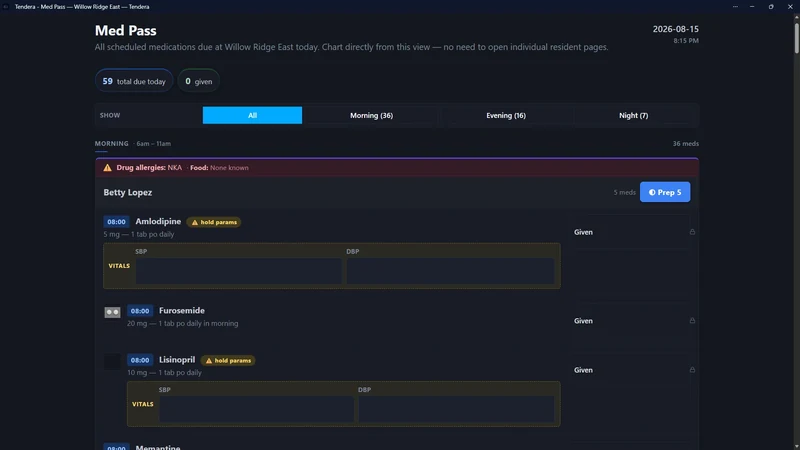
Tendera doesn't monitor the physical cabinet, the refrigerator temperature, or the location of any given bottle. It supports the medication-management documentation that surrounds those physical decisions and does not replace practitioner direction, pharmacy expertise, or facility policy.
FAQ
Does medication have to be locked in an Arizona assisted living facility?
When medication is stored by the facility, R9-10-817(F) requires a separate locked room, closet, cabinet, or self-contained unit used only for medication storage. Medication a resident keeps in their bedroom or residential unit is addressed separately under R9-10-817(H) and tied to the resident's service plan.
Can medications be stored in a resident's room?
Yes, under the applicable rule. R9-10-817(H) requires that a resident's bedroom or residential-unit medication is stored according to the resident's service plan — or that the service plan is updated to reflect how the medication is actually being stored. The rule does not automatically force every resident's medication into the facility's central locked cabinet.
Can we store medication in the same cabinet as other supplies?
Not for facility-stored medication. R9-10-817(F)(1) specifically requires that the medication storage location be used only for medication storage. A cabinet that also holds cleaning supplies, snacks, or resident paperwork isn't a medication-only cabinet under the rule.
What temperature does the rule require for the medication refrigerator?
The Arizona rule does not name a specific medication-fridge temperature. R9-10-817(F)(2) requires that medication be stored according to the instructions on the container. If the container says "refrigerate 36°F to 46°F," that's the range that applies to that medication. A fridge log is a reasonable operational practice; the compliance question is whether each medication is actually being stored the way its own label instructs.
How should controlled substances be stored?
R9-10-817(F)(3)(d) requires policies and procedures for storing, inventorying, and dispensing controlled substances. The rule doesn't specify count frequencies, particular container types, or a specific dual-signature format. Those are facility-level decisions made in consultation with the consulting pharmacist, and controlled substances also sit inside a separate federal framework.
What medication-storage policies does an assisted living facility need?
Under R9-10-817(F)(3), the facility must have written procedures for receiving, storing, inventorying, tracking, dispensing, and discarding medication (including expired medication); for manufacturer-requested discard or return of prepackaged and sample medication; for a medication recall and notification of residents who received the recalled medication; and for storing, inventorying, and dispensing controlled substances. The policies must also be implemented, not just filed.
Primary authority & further reading
- Arizona Administrative Code, Title 9, Chapter 10 (Health Care Institutions Licensure), published by the Arizona Secretary of State.
- R9-10-817 — Medication Services. Subsection (F) governs facility-stored medication. Subsection (H) governs medication stored by a resident in the resident's bedroom or residential unit.
- Companion resource: Arizona Assisted Living Medication Management Requirements — the broader medication-services picture, including administration, assistance in self-administration, verbal orders, and documentation.
- Companion resource: Arizona Assisted Living Service Plan Requirements — especially relevant to resident-room medication arrangements.
- Arizona Department of Health Services — Residential Facilities Licensing, the licensing agency for Arizona assisted living facilities.
Regulatory history: Arizona's assisted-living rules were amended in 2025. The current medication-services section, R9-10-817, became effective June 30, 2025. Storage policies, checklists, and training materials that predate June 30, 2025 should be reviewed against the current rule.
Last reviewed: August 2026.
This resource provides general information for Arizona assisted living operators and is not legal, medical, pharmacy, or professional advice. Regulations and agency guidance may change. Operators should verify current requirements with ADHS, applicable Arizona law, medical practitioners, pharmacists, and other qualified professionals as appropriate to their facility and residents.